
Explore More Professional Development Resources
Practical Learning. Meaningful Conversations. Stronger Institutions.
Professional development is most valuable when it encourages reflection, strengthens understanding, and creates opportunities to apply new ideas in everyday institutional operations.
The Rosenboom Workforce Institute continues to expand its collection of complimentary professional development resources designed for higher education employees, supervisors, and institutional leaders.
These resources introduce important topics in financial aid administration, employee engagement, workplace satisfaction, organizational leadership, and institutional effectiveness. Each offers practical insights, opportunities for reflection, and ideas you can explore individually or in departmental discussions.
Many of these complementary resources also introduce topics explored more extensively in our published professional development workbooks, which offer additional exercises, realistic scenarios, discussion questions, and practical applications.
Explore the resources, share them with colleagues, and find new ways to strengthen your institution through ongoing learning and professional engagement.
Three Decisions, One Eligible Student
Understanding Student Eligibility, Verification, and Professional Judgment
Determining a student's eligibility for federal financial aid involves more than reviewing an application. Financial aid professionals must evaluate eligibility requirements, resolve conflicting information, complete applicable verification procedures, and exercise professional judgment when individual circumstances warrant consideration.
The Rosenboom Workforce Institute's first featured CFAA collection brings together three professional development workbooks from the CFAA Prep in Practical Terms series:
Student Eligibility
Verification
Professional Judgment
Each workbook provides practical regulatory instruction, realistic institutional scenarios, guided exercises, and model explanations designed to help financial aid professionals strengthen their knowledge, decision-making, and documentation practices.
Together, these publications encourage a thoughtful, consistent, and well-documented approach to administering federal student aid while recognizing the importance of individualized student circumstances and institutional responsibilities.
A complimentary 21-page facilitator's guide, Three Decisions, One Eligible Student, introduces the collection through three interactive professional development sessions. Following a fictional student through eligibility review, verification, and professional judgment, participants explore how these interconnected decisions influence the financial aid process.
The complimentary guide introduces the learning experience, while the three companion workbooks provide the deeper instruction, additional case studies, exercises, and reference materials for continued professional development.
Three decisions. One eligible student. A shared commitment to accurate, thoughtful, and compliant financial aid administration.
Three Responsibilities, One Financial Aid Award
Connecting Satisfactory Academic Progress, Packaging, and Loan Disbursement
A financial aid award represents more than a collection of grants and loans. Behind every award are important decisions involving student eligibility, academic progress, federal financial aid requirements, and the accurate administration of financial assistance.
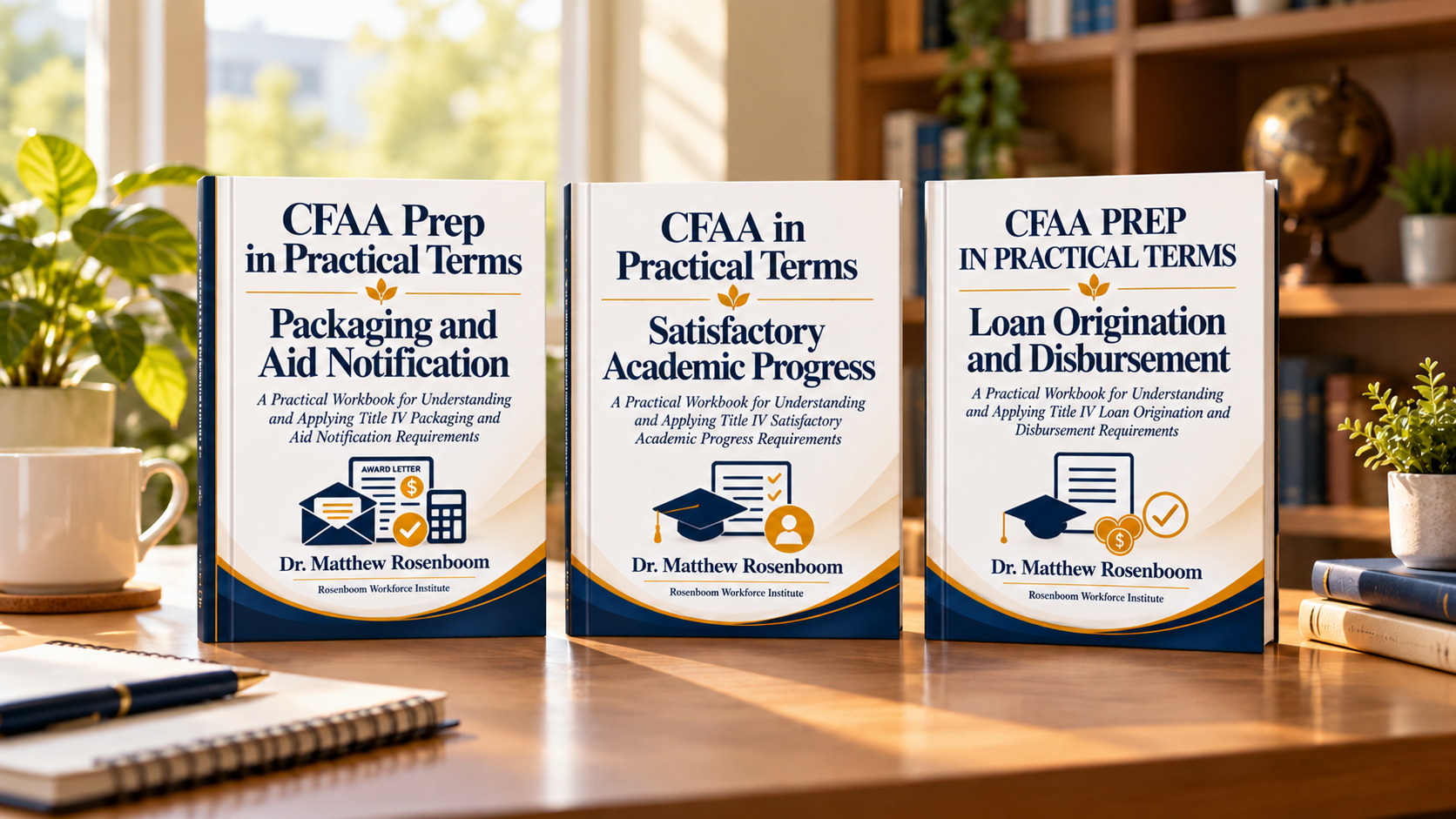
The Rosenboom Workforce Institute's second featured CFAA collection brings together three professional development workbooks from the CFAA Prep in Practical Terms series:
Satisfactory Academic Progress
Packaging and Aid Notification
Loan Origination and Disbursement
Each workbook provides practical regulatory instruction, realistic institutional scenarios, guided exercises, and model explanations designed to strengthen financial aid professionals' understanding of Title IV administration.
Together, these publications explore how academic progress determinations, award packaging, student communications, loan processing, and disbursement requirements intersect throughout the financial aid process.
A complimentary 22-page facilitator's guide, Three Responsibilities, One Financial Aid Award, introduces the collection through three interactive professional development sessions. Following a fictional continuing student, participants examine academic progress, evaluate award information, consider loan processing requirements, and discuss the documentation necessary to support accurate decisions.
The complimentary guide introduces the learning experience, while the three companion workbooks provide the deeper regulatory instruction, additional case studies, practical exercises, and reference materials for continued professional development.
Three responsibilities. One financial aid award. A shared commitment to accurate, responsible, and student-centered financial aid administration.
Three Obligations, One Accountable Institution
Connecting Return of Title IV Funds, Reconciliation and Reporting, and Consumer Information Requirements
Institutional accountability in federal student financial aid extends beyond determining eligibility and disbursing funds. Colleges and universities must also manage student withdrawals, reconcile federal financial transactions, maintain accurate records, and communicate required information clearly and consistently.
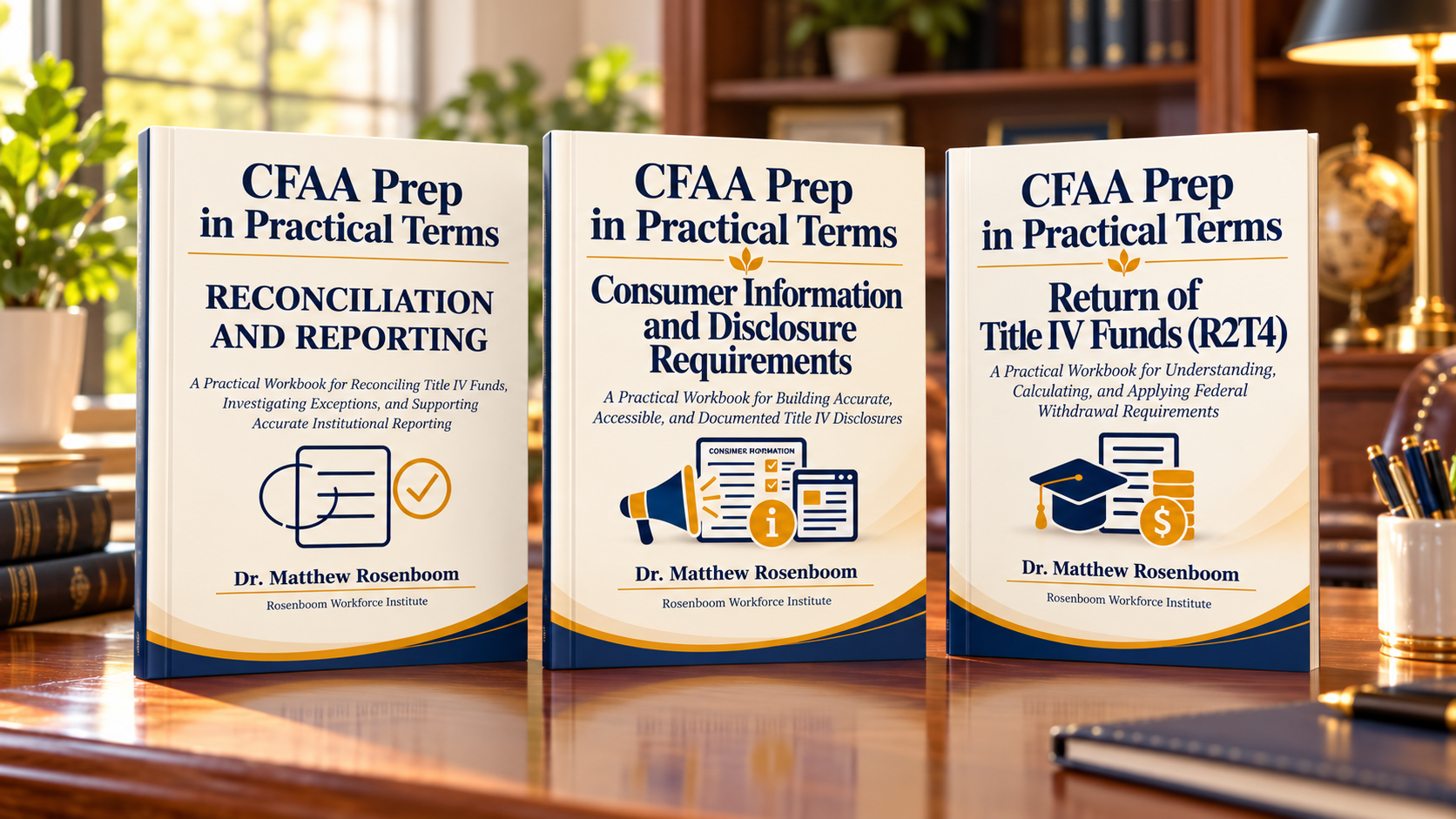
The Rosenboom Workforce Institute's third featured CFAA collection brings together three professional development workbooks from the CFAA Prep in Practical Terms series:
Return of Title IV Funds (R2T4)
Reconciliation and Reporting
Consumer Information and Disclosure Requirements
Each workbook provides practical regulatory instruction, realistic institutional scenarios, guided exercises, and model explanations designed to strengthen financial aid professionals' understanding of Title IV compliance and institutional accountability.
Together, these publications demonstrate how withdrawal determinations, financial reconciliation, institutional reporting, and consumer disclosures represent distinct but interconnected responsibilities. Effective administration requires accurate decisions, clear communication, appropriate documentation, and coordination among institutional departments.
A complimentary 22-page facilitator's guide, Three Obligations, One Accountable Institution, introduces the collection through three interactive professional development sessions. Following a fictional student withdrawal, participants examine institutional responsibilities, investigate financial discrepancies, evaluate student communications, and discuss practical approaches to maintaining compliance.
The complimentary guide introduces the learning experience, while the three companion workbooks provide deeper regulatory instruction, additional case studies, practical exercises, and reference materials for continued professional development.
Three obligations. One accountable institution. A shared commitment to accurate, transparent, and responsible Title IV administration.
Better Together: When Admissions and Financial Aid Work as One Team
Strong collaboration between Admissions and Financial Aid can make a meaningful difference in the student enrollment experience.
This complimentary guide from Rosenboom Workforce Institute explores how these two essential departments can strengthen communication, improve student handoffs, and work together more effectively.
Featuring realistic workplace scenarios, guided discussions, practical exercises, and a 30-day improvement framework, the guide introduces the collaborative approach behind the Better Together professional development workbook series.
Discover how Building a More Engaged Financial Aid Team and Building a More Engaged Admissions and Enrollment Management Team complement one another to support employee engagement, departmental collaboration, and student-centered service.
Two departments. One shared commitment to student success. Better Together.
When Good Employees Begin to Disengage
Understanding the Connection Between Employee Recognition, Motivation, and Engagement in Higher Education
Institutions invest considerable resources in recruiting qualified employees, developing their skills, and retaining experienced professionals. Yet one of the most significant threats to workforce stability can develop quietly, long before an employee submits a resignation.
Employees may continue reporting to work, completing assigned responsibilities, and meeting basic expectations while gradually withdrawing the discretionary effort, initiative, creativity, and commitment they once contributed. In other situations, employees may begin to feel that their experience, ideas, contributions, and professional judgment are no longer recognized or valued.
These experiences are related, but they are not identical. Understanding both is essential for institutional leaders who want to identify and address the conditions contributing to workforce disengagement.
Why These Two Workbooks Belong Together
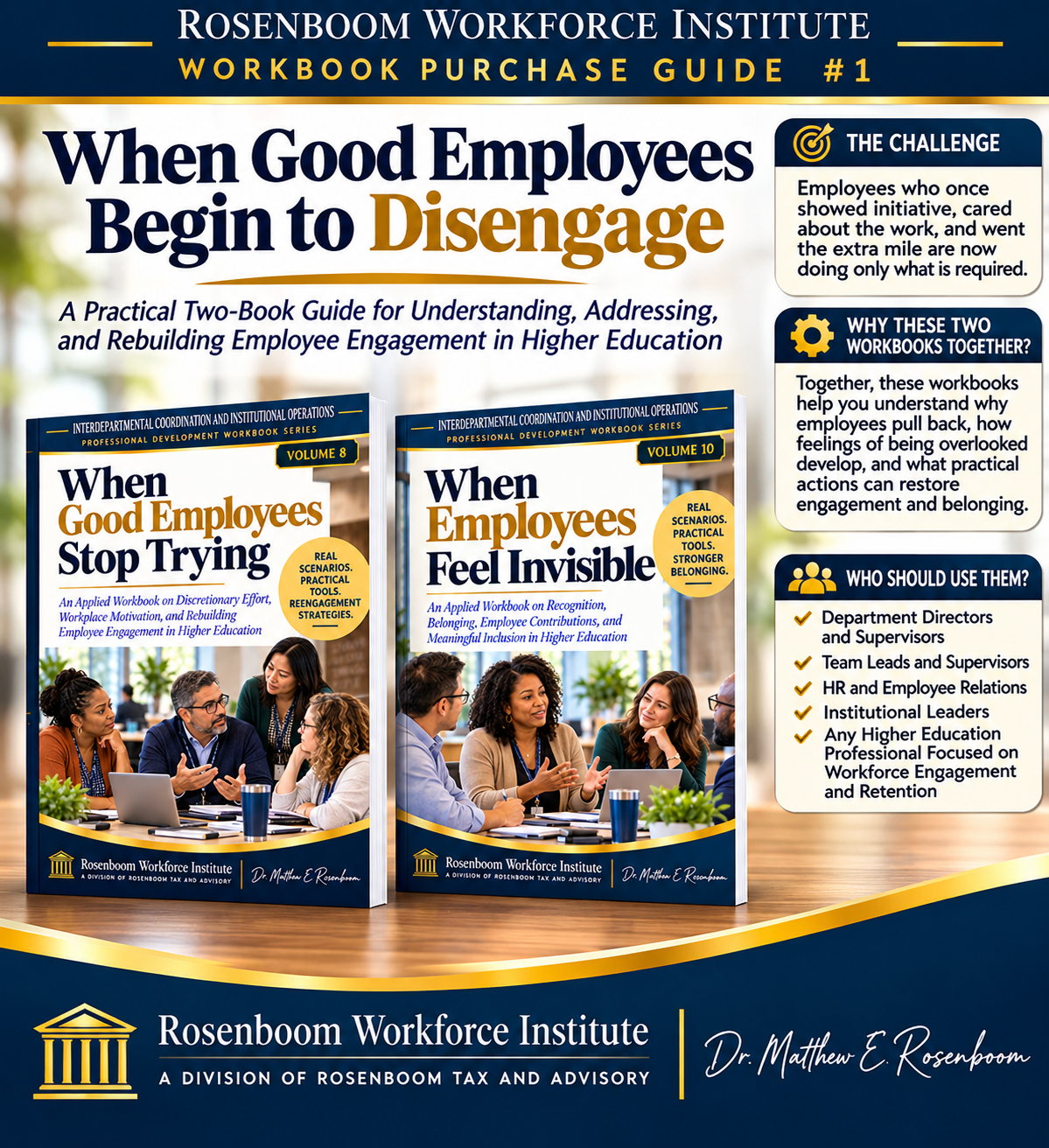
Workbook 1: When Good Employees Stop Trying — Volume 8
An Applied Workbook on Discretionary Effort, Workplace Motivation, and Rebuilding Employee Engagement in Higher Education
This workbook examines what happens when capable employees begin reducing their discretionary effort. It encourages readers to consider the workplace experiences and organizational conditions that can influence motivation, initiative, and employee engagement.
Workbook 2: When Employees Feel Invisible — Volume 10
An Applied Workbook on Recognition, Belonging, Employee Contributions, and Meaningful Inclusion in Higher Education
This companion workbook focuses on the employee experience of feeling overlooked, unheard, or undervalued. It examines the importance of recognition, belonging, meaningful participation, and acknowledgment of employee contributions.
The connection: One workbook examines the withdrawal of discretionary effort; the other examines workplace experiences that may contribute to that withdrawal. Together, they provide complementary perspectives on employee engagement and workforce stability.
What Institutions Can Gain From Using Both
When considered together, these workbooks can help institutional leaders, supervisors, and employees examine the relationship between workplace conditions and employee behavior.
Readers are encouraged to consider whether declining initiative reflects an individual performance issue, an organizational condition, or some combination of the two. They can also examine whether employees have meaningful opportunities to contribute, whether their work is recognized, and whether leadership practices support sustained engagement.
The combined approach is particularly relevant in higher education, where employees frequently manage complex responsibilities, regulatory requirements, competing institutional priorities, and student expectations.
An employee who feels invisible may eventually stop volunteering ideas, identifying problems, recommending improvements, or taking initiative beyond assigned duties. Those changes can affect not only the employee but also colleagues, departmental effectiveness, and the students the institution serves.
Who Should Consider This Pairing?
These workbooks are particularly relevant for college and university presidents, campus leaders, department directors, supervisors, human resources professionals, organizational development practitioners, and employees interested in understanding workforce engagement.
They may also be useful for institutional leadership teams seeking to strengthen employee retention, improve communication, and examine the organizational conditions influencing workforce performance.
Why Purchase Both?
Purchasing only When Good Employees Stop Trying provides a focused examination of declining discretionary effort and workplace motivation.
Purchasing only When Employees Feel Invisible provides a focused examination of recognition, belonging, and meaningful inclusion.
Purchasing both allows readers to explore how these experiences may intersect. Rather than treating disengagement as an isolated employee behavior, the pairing encourages a more complete examination of the conditions that can influence whether employees remain invested in their work.
Explore the Workbooks
Both titles are part of the Rosenboom Workforce Institute's Interdepartmental Coordination and Institutional Operations Professional Development Workbook Series.
Visit the Rosenboom Workforce Institute bookstore to explore these titles and other research-informed professional development resources.
Rosenboom Workforce Institute
A division of Rosenboom Tax and Advisory
Research-Informed Professional Development
Bookstore: https://www.lulu.com/spotlight/rosenboomworkforceinstitute
Rebuilding Trust Between Employees and Leadership
Trust is essential to workforce engagement, institutional stability, and organizational effectiveness. When employees lose confidence in leadership, communication suffers, discretionary effort declines, and institutional relationships can deteriorate.
This complimentary 19-page facilitator's guide explores how organizational trust breaks down and how meaningful listening, employee voice, accountability, and leadership follow-through can help rebuild it. Featuring realistic higher education scenarios, three facilitated learning sessions, discussion exercises, practical tools, and a 30-day improvement plan, the guide provides an opportunity for individual reflection or team-based professional development.
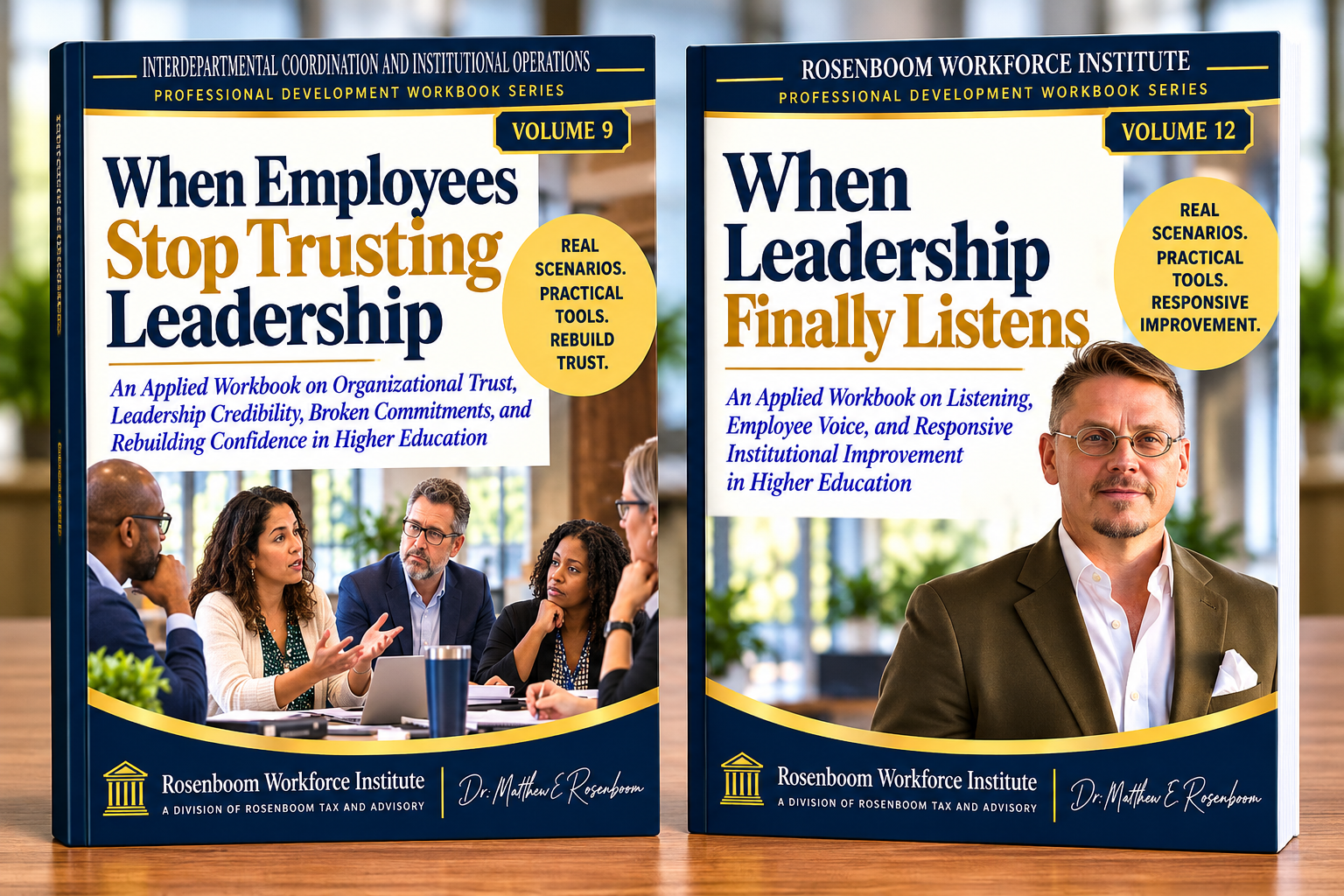
The guide complements two Rosenboom Workforce Institute workbooks: When Employees Stop Trusting Leadership (Volume 9) and When Leadership Finally Listens (Volume 12), which provide more extensive opportunities for applied learning.
When Nobody Owns the Next Step
A Complimentary Facilitator’s Guide to Accountability, Departmental Handoffs, and Institutional Coordination
When responsibilities are unclear and employees assume someone else is handling the next step, important work can fall between departments. These breakdowns can create processing delays, duplicated efforts, employee frustration, and unnecessary obstacles for students.
This complimentary 19-page facilitator’s guide explores how accountability gaps develop and how institutions can strengthen ownership, communication, and cross-departmental coordination. Featuring realistic higher education scenarios, three facilitated learning sessions, discussion exercises, practical worksheets, and a 30-day improvement plan, the guide provides a structured resource for individual reflection or team-based professional development.
The guide complements two Rosenboom Workforce Institute workbooks: Who Owns the Next Step? (Volume 3) and When Everyone Thinks Someone Else Is Handling It (Volume 4), which provide more extensive opportunities to examine departmental handoffs, responsibility, and institutional accountability.